
How to Honor Your Natural Rainbow Pregnancy Preparation Style
Have you noticed how pregnancy preparation advice tends to assume everyone approaches getting ready for baby the same way?

Those typical checklists and timelines don’t account for the complex emotions that come with pregnancy after loss – or how those emotions might affect how we prepare.
Looking back now, I can see that my preparation “style” was mostly shutdown and denial. Every aspect of my rainbow pregnancy overwhelmed me. I was afraid to have baby items in my house. I couldn’t write my due date on the calendar.
When my mom bought those first few tiny items (after checking with me first), they stayed in their shopping bag on my dresser for months. I couldn’t bear to put them away in a drawer – that felt too real, too hopeful.
At the time, I didn’t understand why I was having such a hard time with what seemed like simple tasks. I just knew I couldn’t do them.
If you’re finding yourself struggling to engage with preparation – whether that means avoiding it entirely, obsessing over every detail, or somewhere in between – you’re not alone.
The way we approach preparation often mirrors the emotional patterns we’ve developed to protect ourselves after loss. Today, we’ll focus specifically on how those emotional responses show up in preparation tasks and explore practical strategies for working with your natural style, not against it.
A Quick Disclaimer
Before we move on I want to state VERY CLEARLY that I am neither a Medical Health Care Provider nor a Mental Health Care Provider. Nothing I write here should be taken as medical advice. I am simply here to share my own experiences in the hope it will help someone feel less alone, and possibly avoid some of the mistakes I made along the way.
If you have any questions or concerns about your pregnancy or your emotional state, PLEASE seek help from a professional.
Table of Contents
Understanding Different Preparation Styles
When it comes to preparing for your rainbow baby, there’s no single “right approach.” Different styles work for different parents, and your approach might even change as your pregnancy progresses.

Studies on perinatal loss have found that preparation styles often mirror our underlying emotional response patterns.
Some parents cope through avoidance, while others seek control through planning. Many slide back and forth along the scale between these extremes, making it difficult to find solid footing.
All are valid, protective responses to past trauma. If you’d like to explore those emotional patterns in more depth, I cover them fully in my post on
Emotional Response Patterns in Rainbow Pregnancy.
To learn more about the impact of trauma on pregnancy, Michigan Medicine has some helpful information.
Let’s explore these different styles to help you understand where you might be right now – keeping in mind that your style might shift throughout pregnancy, and that’s also completely normal.
The Minimal Preparation Style – (Protective Withdrawal Response)

Some parents need to keep preparation as simple and streamlined as possible. This might look like:
- Focusing only on absolute necessities
- Delegating most preparation tasks to support people
- Avoiding planning in advance when possible
- Taking things one day at a time
- Protecting yourself from overwhelming details
You might resonate with this style if you find yourself:
- Feel a wave of anxiety when someone asks about baby preparations
- Keep pregnancy appointments off your main calendar
- Find yourself changing the subject when people ask about nursery plans
- Feel more comfortable thinking about pregnancy one day at a time
- Notice relief when someone offers to handle preparation tasks for you
- Prefer not to have baby items visible in your home yet
- Feel overwhelmed looking at baby registry websites
- Experience physical tension when walking through baby stores
- Avoid making decisions about baby items whenever possible
- Find comfort in keeping preparations minimal and essential
This was my primary style during my rainbow pregnancy. Those first few items my mom bought that I mentioned above – while I couldn’t bring myself to take them out of the shopping bag, I also couldn’t return them.
So they lived there on my dresser, in a kind of preparation limbo that matched exactly where I was emotionally.
This approach isn’t about lack of care or commitment – it’s a protective response that helps create the emotional distance needed to navigate pregnancy after loss.
If you want to know more about this prep style, I shared my own experience with it and the emotional protection denial offered in Why I Couldn’t Prepare for my Rainbow Baby.
The Detailed Preparation Style – (Control-Seeking Response)

Other parents find comfort and connection in thorough preparation, using planning and research as ways to create safety and connection. This style might show up as:
- Researching every possible option for baby items
- Creating detailed planning spreadsheets
- Organizing everything well in advance
- Finding peace in having things “just right”
- Using preparation as a way to bond
You might connect with this style if you:
- Find yourself taking screenshots of nursery ideas that feel “just right”
- Have created folders or Pinterest boards for different baby categories
- Feel drawn to compare safety statistics between different baby products
- Notice yourself planning birth scenarios in specific detail
- Track pregnancy milestones with precise documentation
- Find yourself creating backup plans for your backup plans
- Have already researched pediatricians despite being early in pregnancy
- Feel anxiety ease when you complete a preparation-related task
- Seek out specialized knowledge about baby gear or development
- Find yourself planning several steps ahead of current pregnancy stage
This approach can be healing for some parents, offering a sense of control in an inherently uncertain situation. If this is how you cope best, that’s completely valid. The key is making sure the planning serves you rather than overwhelms you.
The Mixed Preparation Style

Many parents find themselves somewhere in between, or shifting between styles. You might:
- Feel ready to prepare in some areas but not others
- Have good days and overwhelmed days
- Handle practical tasks while avoiding emotional ones
- Need different approaches at different stages
- Find your style changing as pregnancy progresses
I find this is where most rainbow parents land – somewhere in this middle space where some preparations feel manageable and others feel impossible.
I ended up in this middle ground a lot. It can make you feel a bit out of sorts. I didn’t understand all of the reasoning behind why I could do some things and not others back then so I just assumed there was something wrong with me.
Or that I was maybe losing my mind a bit. But no, as with many major life moments, hindsight really does clear a lot of things up.
You might be taking a mixed approach if you:
- Feel comfortable researching car seats but avoid looking at nursery furniture
- Find yourself engaged with preparation on good days, then completely disconnected on harder days
- Notice your preparation tolerance changes around significant dates (like loss anniversaries)
- Can talk about some preparations with certain people but not others
- Have preparation “safe zones” (topics that feel okay) and “trigger zones” (topics that feel impossible)
- Experience shifts in preparation comfort after specific milestones (like anatomy scans or entering a new trimester)
- Feel ready to prepare certain items yourself but need others kept out of sight
- Find your engagement changes based on physical symptoms or stress levels
- Can handle preparing for baby’s needs but struggle with self-care preparations (like postpartum supplies) or vice versa
This variable comfort with different aspects of preparation is completely normal. You might schedule medical appointments without hesitation but freeze when someone asks about baby clothes.
Or perhaps you’re comfortable discussing nursery color options with family but struggle to engage in a conversation about birth preferences with your provider.

These seemingly contradictory responses aren’t a sign of inconsistency – they’re your mind’s way of creating balance between protection and preparation, navigating what feels manageable in each moment.
This kind of inner conflict is part of what we call the Preparation Paradox—something we unpack more deeply in Understanding the Preparation Paradox in Rainbow Pregnancy.
The key is not which style you fall into, but how to work with your style to meet both your practical needs and emotional well-being. Now let’s explore specific strategies for working with each approach.
Practical Strategies for Different Preparation Styles
Understanding your preparation style is helpful, but knowing how to work with it is what truly makes a difference. Let’s explore strategies tailored to each approach.
Throughout this section, you’ll find journaling prompts in call-out boxes like this one.
These prompts are offered as optional tools for exploring your own feelings and decisions about your rainbow pregnancy.
There’s no pressure to engage with them – they’re simply here if you find writing helpful for processing complex emotions.
Think of them as a quiet space to explore your thoughts at your own pace, with no right or wrong answers. Whether you prefer to write, reflect silently, or simply keep reading, the choice is yours.
For more guidance on organizing practical steps regardless of your style, see Managing Practical Preparation in Rainbow Pregnancy.
Working with a Minimal Preparation Style
If you find yourself taking a minimal approach to preparation, these strategies might help you handle what needs to happen while still protecting your heart:
Break Tasks Down into Micro-Steps
Sometimes the smallest preparations can feel overwhelming. Try breaking essential tasks into the tiniest possible steps. For example, instead of “prepare nursery,” you might:
- Ask someone else to research safe sleep spaces
- Have someone store the bassinet out of sight until needed
- Focus only on the absolute minimum for bringing baby home
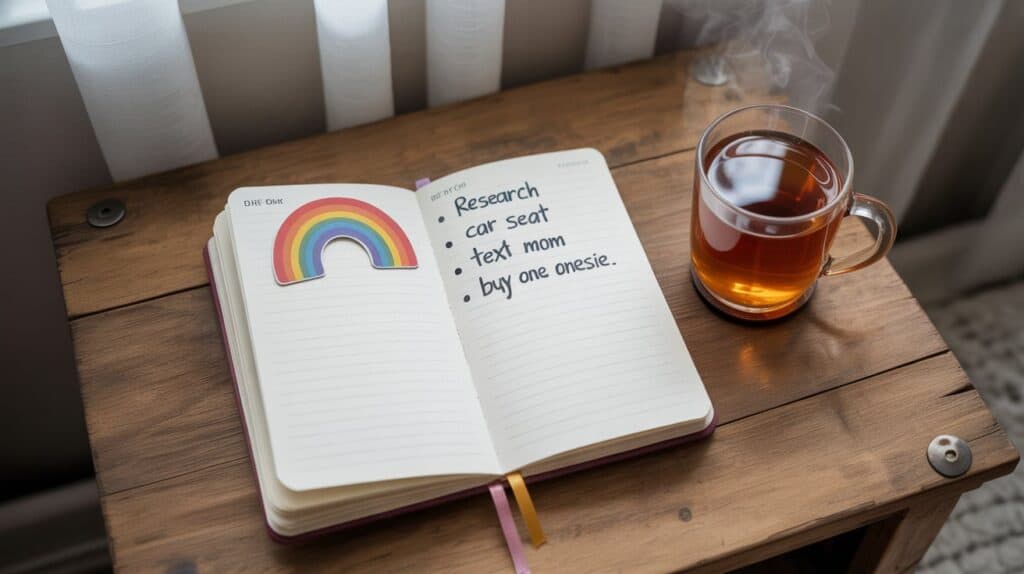
Sometimes I couldn’t even think about buying anything, much less actually make a purchase. So I floundered and ended up purchasing a car seat the night before I was admitted to the hospital for the birth of my rainbow.
But I could have handled my support person saying “I found three car seat options that all meet safety standards – should I order the one with the highest safety rating?” Or even just choosing from those three options instead of having to narrow it down from the wide world of carseat options.
Use Physical Boundaries
Creating physical boundaries around preparation can help make it feel more manageable:
- Have a support person store baby items until you feel ready to have them at home
- Keep necessary items in closed drawers or closets if having them visible feels too overwhelming
- Have a separate calendar or note system for pregnancy-related dates

Delegate When Possible
For tasks that feel too overwhelming, consider:
- Asking a partner, family member, or friend to handle specific preparations
- Being clear about what you can and can’t handle right now
- Setting up a system where your support person checks in before making decisions
Remember, taking a minimal approach doesn’t mean you care any less – it’s simply what your heart needs to feel safe right now.
Journaling Prompts for the Minimal Style
If you are finding that preparations are so overwhelming or so hard to initiate that you aren’t getting anywhere, or if you just want to give writing a try, journaling can be a good way to help you sort out the battle between a need to prepare and a protective avoidance.
Here are a few prompts you could try:
📝What is one small preparation step that feels possible right now?
📝What specific aspects of preparation feel most overwhelming?
📝What might help make one essential task feel safer?
📝What boundaries around preparation help you feel most protected?
📝How might your support person help with one specific preparation need?
Working with a Detailed Preparation Style
If you find comfort in thorough planning and detailed preparation, these strategies can help you use this approach in ways that support rather than overwhelm you:
Create Boundaries Around Research
It’s easy for research to become all-consuming. Try:
- Setting specific time limits for research sessions
- Having someone check in if you’ve been researching for longer than planned
- Creating separate folders or notebooks for different preparation categories
- Taking scheduled breaks from preparation research

Balance Control and Flexibility
While detailed planning can create a sense of control, pregnancy and birth rarely go exactly as planned. Try:
- Identifying which aspects of preparation actually allow meaningful control
- Creating primary plans and contingency options
- Focusing on decisions that make the biggest difference in outcomes
- Building flexibility into your preparation approach
Monitor for Diminishing Returns
Notice when additional research or planning stops providing real benefit:
- Ask yourself: “Will more information actually change my decision?”
- Notice when planning starts to increase rather than decrease anxiety
- Be aware of when perfectionism rather than genuine care is driving choices
- Give yourself permission to stop researching when you have enough information

Your detail-oriented approach can be a tremendous strength when channeled effectively. The key is making sure it serves your wellbeing rather than becoming another source of stress.
Journaling Prompts for the Detailed Style
Sometimes it can be really hard to put a full stop on research mode. If you are struggling to disengage from research and are going deeper down rabit holes than is actually helpful, funneling some of that control-seeking energy into journaling might be helpful.
Here are a few prompts you could try:
📝When does my research or planning feel most helpful versus most overwhelming?
📝What three preparations have brought me the most peace so far?
📝How can I tell when I’ve reached “enough” information on a preparation topic?
📝What would a balanced preparation approach look like for me?
📝What preparation areas might benefit from less detailed focus?
Working with a Mixed Preparation Style
If you find your preparation style shifts or combines elements of both approaches, these strategies might help:
Create Flexible Systems
Develop preparation approaches that can adapt to your changing needs:
- Have both minimal and detailed planning options ready
- Create modular preparation lists that can be expanded or simplified
- Develop communication systems with support people that allow for changing needs
- Prepare for both high-engagement and low-engagement days
Preparation Triage

Create systems for identifying what truly needs attention versus what can wait:
- Keep a simple list of time-sensitive preparations
- Have a separate list for optional preparations that feel manageable
- Create a “later if ever” list for things that feel overwhelming now
- Revisit these lists periodically as your capacity changes
The key with a mixed approach is developing the self-awareness to recognize shifts and having systems in place that can adapt accordingly.
Journaling Prompts for the Mixed Style
If the fluctuations between preparation energy are making your head spin, that’s perfectly normal. Journaling may help you find your rhythm.
Here are some prompts you can try:
📝What preparation tasks feel manageable today versus overwhelming?
📝What patterns have I noticed in when my preparation capacity changes?
📝What signals tell me I need to step back from preparation for a while?
📝What helps me re-engage with preparation after difficult periods?
📝How might my support system adapt to my changing preparation needs?
Finding Support for Your Preparation Style
Working with your preparation style doesn’t mean you have to do it all alone. In fact, having the right kind of support can make an enormous difference in how manageable preparation feels.

Different preparation styles benefit from different types of support:
- Protective preparation approaches often need help with essential tasks and respectful boundaries
- Control-seeking preparation approaches may need support with balancing research and preventing overwhelm
- Mixed preparation approaches benefit from flexible support that can adapt to changing needs
The key is finding support that complements your natural preparation style rather than works against it.
For guidance on finding your initial support person, see Finding Your Initial Support Person for Rainbow Pregnancy.
And if you’re navigating different preparation styles with a partner or want to better understand each other’s coping needs, our Couple’s Guide to Rainbow Pregnancy offers gentle conversation prompts and connection strategies:

Are you and your partner feeling overwhelmed as you prepare for your Rainbow Baby?
Our free Together Through the Rainbow Guide offers a roadmap for couples, helping you navigate the unique emotional challenges and practical preparations that come with rainbow pregnancy. Learn how to support each other through this journey and feel more prepared and connected as you plan for your baby’s arrival.
Get your free toolkit now and find your footing together as a team.
Finding Your Rhythm
A lot of the turmoil I felt during my rainbow pregnancy was about feeling like I wasn’t doing the things or feeling the feels I thought I was “supposed to.”
So I want to be clear that the work we’ve done here to understand your preparation style has not been about helping you change it. There is nothing wrong with you, your response to your pregnancy, or how you go about preparing for the birth of your rainbow.

Instead, the goal here is to find ways to work with it that honor both your emotional needs and the practical realities of pregnancy. To help you find as much peace as possible during this time.
Whether you tend toward minimal preparation, detailed planning, or find yourself moving between these approaches, your pattern makes sense. It’s your brain’s way of creating safety in an inherently uncertain journey.
In our next posts in this series, we’ll explore how these preparation styles might shift throughout pregnancy and practical planning frameworks that can adapt to your needs. For now, remember:
- Your preparation style is a valid response to previous loss
- Different approaches work for different parents
- Support can be tailored to your specific needs
- Essential tasks can be approached in ways that feel safer
- Working with rather than against your natural style creates more peace
If you’re looking to understand what preparations are truly essential versus optional, see my post on Essential vs Optional: A Basic Framework for Rainbow Pregnancy.
And if you’re ready to explore handling optional preparations in a way that feels safe, check out Your Terms, Your Time: 5 Rainbow Pregnancy Preparations You Can Say No To.
If you’d like to connect with others who understand this complex journey, consider joining our private Facebook group for rainbow parents-to-be. You’ll find a community that understands the delicate balance of preparing while protecting your heart.

Before you go, I want to reiterate VERY CLEARLY that I am neither a Medical Health Care Provider nor a Mental Health Care Provider. Nothing I have written here should be taken as medical advice. PLEASE seek help from a professional if you have any questions or concerns about your pregnancy or your emotional state.
Please Pin One of the Images Below, It’s a BIG Help for My Blog!
Thank you!

Hi!
I’m Jess,
the heart behind The Thing About Rainbows. After experiencing the profound loss of a pregnancy and the journey that followed, I created this space to support and guide women through similar challenges. I am so glad you found your way here. You are not alone.


3 Comments